


The Attention Economy and Brands · Part Two
You measure temperature with a thermometer and speed with a stopwatch. Nobody looks at a stopwatch, fails to find a temperature and concludes that temperature does not exist. In a budget meeting, the equivalent can happen when one activity is judged only through a measurement designed for another.
I have watched brand spending get questioned because its return was difficult to attribute, while performance spending seemed easier to defend because a dashboard attached revenue to it. Neither side needed to be dishonest. The procedure itself gave one kind of evidence an advantage.
That is the argument here: measurement can affect which investments are defensible before their underlying value has been properly compared.
1. The advantage is partly in the procedure
A number comes with something to discuss. Someone can inspect its definition, compare it with last quarter and ask who is responsible for it. A claim about building mental availability can be tested too, but it is easier to set aside if the team has not specified how or when.
The uncomfortable possibility is that wrong-and-checkable can beat right-and-uncheckable. A last-click report may accurately record which interaction received credit while still being a poor estimate of what caused the sale. Yet it gives a decision-maker something concrete to show.
In an organisation that rewards short-term, traceable results, that can create an accountability advantage. The measurable option may be easier to defend even when its measurement omits important effects. This is a tendency shaped by the organisation’s rules, not a law of every budget meeting.
Digital platforms intensify it by putting exposure, interaction and purchase records close together. Social commerce can make that proximity particularly persuasive: the content and the transaction appear in the same reporting environment. But being recorded together does not, by itself, establish how much one caused the other.
2. Attribution can understate brand’s contribution
Brand activity may affect purchases later or through another channel. Last-click attribution assigns credit to the final recorded interaction; it does not isolate the contribution of everything that preceded it. That final interaction is not necessarily a paid ad, either.
The risk is that activity close to purchase receives credit for demand partly created elsewhere. If future budgets follow that credit, the measurement can help reproduce its own bias. It does not follow that every brand investment works, or that performance advertising merely harvests demand. Both questions require evidence.
The adidas case is useful here. Reporting on Simon Peel’s 2019 presentation described an advertising split of 23% brand and 77% performance. Its econometric analysis attributed 65% of sales across wholesale, retail and ecommerce to brand activity—not 65% of ecommerce sales alone. The same report said performance activity also contributed to wholesale and retail sales.
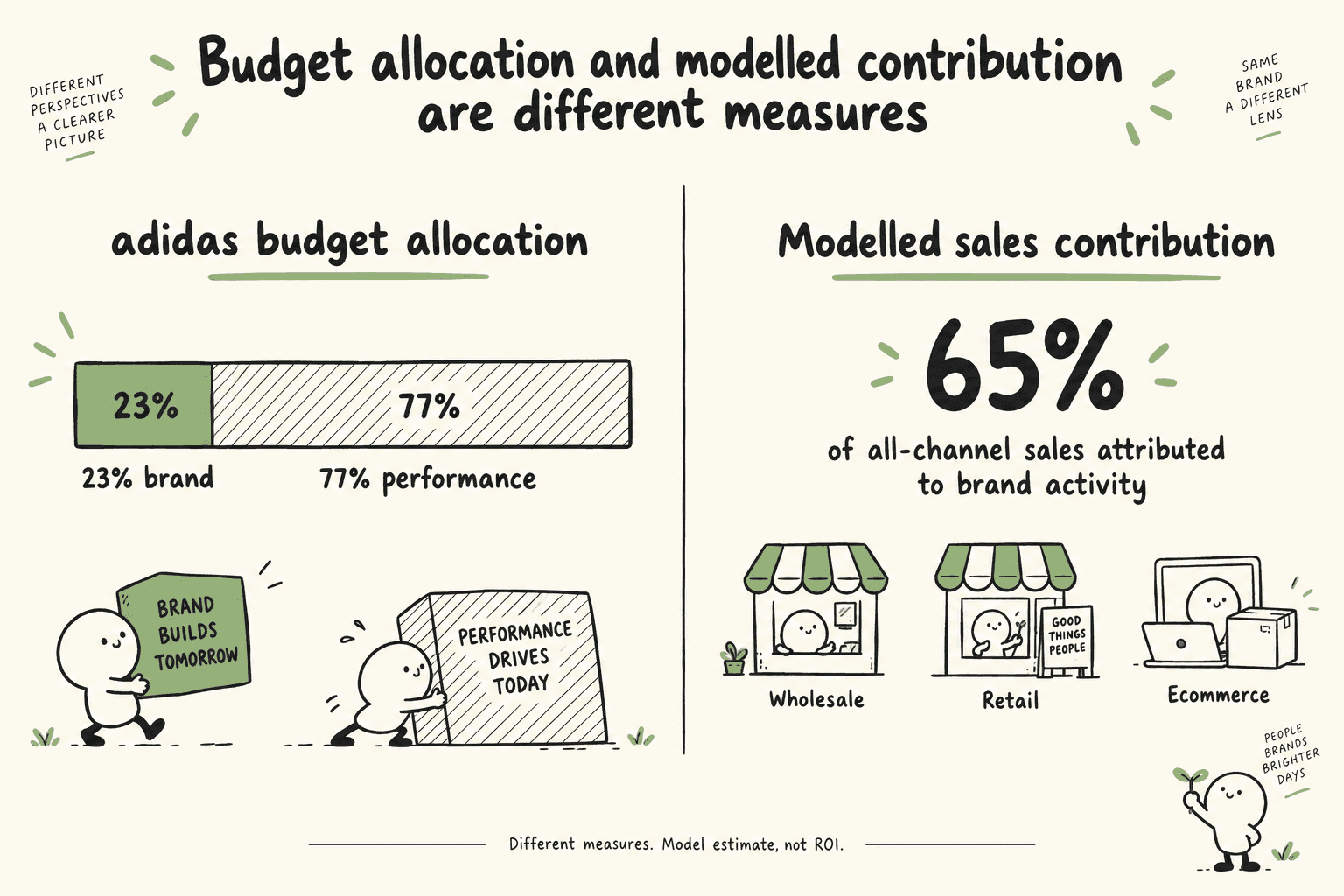
Figure 1. Adidas’s reported budget allocation and modelled sales contribution describe different measures; they are not an ROI calculation. Source: Marketing Week, 17 October 2019.
That is the more interesting finding: effects crossed the boundaries the company had assumed. It is a reported company analysis, not a universal allocation rule. It also does not prove that another company should copy adidas’s subsequent decisions.
The conclusion I would carry into another business is narrower. A platform-attributed sale and an incremental sale are not interchangeable. Before moving budget, ask what the current method can observe, what it leaves out and which alternative explanation would change the decision.
3. Different indicators answer different questions
Brand teams do not help themselves by treating measurement as impossible. They need measures that match the proposed effect and its time horizon.
Reach, impressions and engagement can describe delivery and response. They are useful for those purposes, but do not by themselves show a durable change in preference. Direct traffic, branded search, willingness to pay and repeat purchase can provide other evidence. They are not pure readings of brand equity: advertising, price, distribution and product experience can influence them too.
Share of search is one possible indicator. It tracks a brand’s share of searches within a defined comparison set. It does not tell us that searchers were untouched by advertising, and an increase could reflect a scandal as well as growing demand. Its meaning depends on the category, the search environment and what else is happening.
The aim is therefore not to replace one supposedly perfect number with another. It is to use several observations to test a specific claim. If the claim is that an investment increases consideration, measure consideration. If it is that it supports a price premium, investigate price acceptance. Be explicit about the gap between the indicator and the outcome it is meant to represent.
4. Use experiments to identify a contribution, not to label the remainder
A geographic holdout can help estimate the incremental contribution of a campaign or channel. It needs a credible comparison, attention to differences between regions and enough time to observe the effect. Simply stopping ads in a few cities is not automatically a sound experiment.
There is also a crucial limit. Withholding performance spend can help estimate the effect of that spend. It does not establish that every sale left over was caused by brand investment. Product demand, availability, recommendations and other activity may all remain.
For longer-term investments, the evaluation window needs to match the claim. That does not mean asking for unlimited patience. It means agreeing in advance on what should change, what evidence would count against the investment and when the decision will be revisited.
Company stage matters as well. A new business may reasonably prioritise immediate acquisition and cash flow. An established business may have accumulated demand that makes a particular paid channel less incremental than its dashboard suggests. Neither case provides a rule for every brand.
5. Put a better question on the table
The answer to weak attribution is not to declare brand valuable by definition. It is to make the investment’s proposed contribution testable without forcing every effect into the same reporting window.
That changes the conversation from “we have a number and you do not” to “what does each number establish?” It also gives a brand team a responsibility: to distinguish evidence of activity from evidence of change, and a plausible explanation from a demonstrated effect.
The thermometer and stopwatch still matter. So does checking whether either instrument is being used correctly. Data becomes useful bargaining power when it makes the decision better, not merely when it makes the slide harder to argue with.
Second in a series on the attention economy and brands. Next: how content selection, user feedback and persuasion interact—and where ELM helps explain the process.
Sources
Marketing Week, “Adidas: We over-invested in digital advertising”, 17 October 2019. Source for the reported adidas allocation and modelling findings.

