


The Attention Economy and Brands · Part One
Chocolate becomes a different product when you give it to someone. Taste and packaging still matter, but the gift also carries a sentence: I remembered you. That is what makes a promotional caption about a chocolate gift box more consequential than it might first appear.
In August 2026, a short video from Dove chocolate’s official flagship-store account attracted criticism during Qixi, a Chinese festival associated with romance and gift-giving. Its caption described someone whose boyfriend had not bought her a gift box, then presented another romantic interest delivering it as a sweet outcome. Some online commenters mocked the product as “cuckold chocolate”.
On 25 August, Dove’s brand account apologised. Its statement said a third-party store-operations team had created and published the video without strictly following the brand’s content-review process. That is an important distinction: the public record supports a failure to follow the process, not a finding that no process existed.
Some discussion framed the incident in terms of morality and cultural sensitivity. Those concerns are part of the reception. I think there is another useful question: what happens when the attention-grabbing part of a message undermines the meaning that helps sell the product?
1. Offence matters. So does what the product is meant to represent.
The useful distinction is not simply between tasteful and tasteless content. A joke can fit one brand’s established associations and conflict with another’s. That does not make an established persona a licence to offend. It means the same device can do different work in different contexts.
For a chocolate gift promoted around a romantic occasion, the relevant context is the relationship between giver and recipient. Presenting a competing romantic interest as the source of the gift can introduce a meaning the buyer does not want the gift to carry.
My reading is that the caption created a conflict with the romantic gifting associations on which the promotion depended. This does not establish that fidelity is Dove’s single defining association, or that cultural attitudes were irrelevant. It explains why evaluating the caption only for its level of explicitness would miss something important.
A more useful review question is: does this message reinforce the reason someone would choose this product in this situation, or make that choice harder to explain?
Nor can the size or duration of the damage be read straight from a trending topic. Public criticism, changes in sales and lasting changes in brand associations are different outcomes. Without evidence tracking those outcomes, I would not claim that the damage was either permanent or gone within a few weeks.
2. A missed review is also a question about how work is organised
“How did this get through review?” is a reasonable question. It becomes more useful when it leads to the system around the individual post.
A large brand may communicate through store accounts, agencies, creators, customer service and several platforms. That creates coordination work. It does not make pre-publication review mathematically impossible, and it does not remove the brand’s ability to decide who can publish in its name.
The public record does not establish the agency’s KPIs, its briefing documents or Dove’s full approval arrangements. It would be speculation to say that the team had only a sales target, no prohibited-content guidelines and no escalation procedure.
What the incident does raise is a set of practical questions. Were standards clear enough for the people producing daily sales content? Which posts required approval? What happened when a familiar online format introduced a relationship or value the brand would not want to endorse? Who had authority to stop publication?
Commercial incentives matter here as a possible mechanism. If a team is rewarded mainly for immediate response, and brand consequences are neither visible nor part of its review, attention can become the easier objective to optimise. That is an explanation to investigate, not an established account of this agency’s contract.
3. You borrow the format, you inherit the subtext
This is the part of meme-borrowing I find most useful to examine. A format is rarely an empty container. It can carry a social role, a target of ridicule or an assumption about what counts as a satisfying ending.
Put a product inside it and those meanings do not disappear. In this case, the attention-grabbing device depended on a romantic boundary being crossed. Calling the outcome sweet made that boundary-crossing part of the sales story.
A stable brand persona can help teams adapt trends. It gives them a reference point for deciding what the brand would say and how it would say it. But it cannot make every execution safe. Context, audience and the particular joke still require judgment.
The useful contrast is between borrowing a format without examining its implications and adapting it deliberately to the brand’s purpose. Neither originality nor familiarity guarantees a good result.
Product category alone is also too blunt a guide. Chocolate can be a low-cost snack in one purchase and an emotionally meaningful gift in another. A low price does not make the meaning of the purchase unimportant. That tension is what makes this case more interesting than a general warning against brands using internet humour.
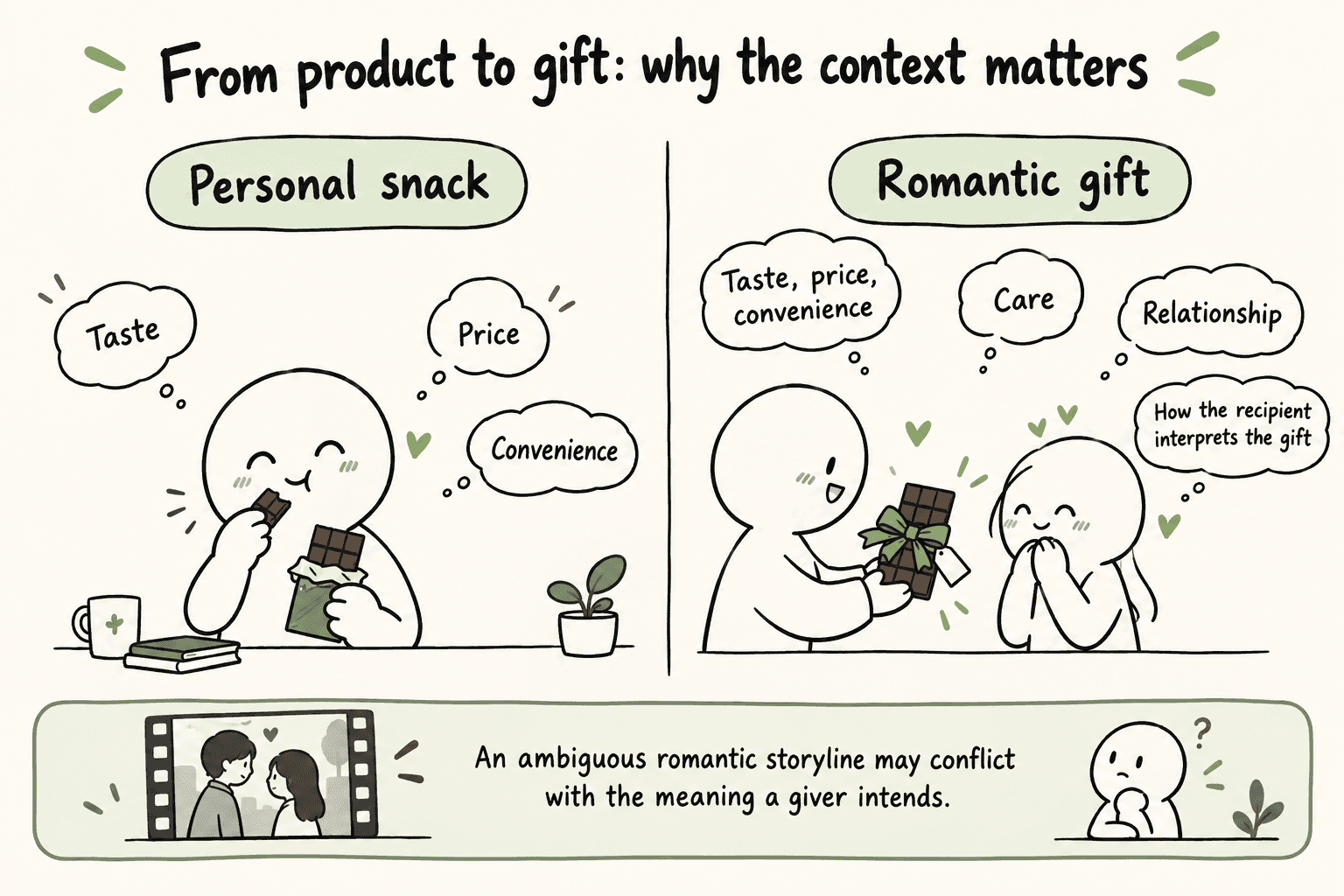
Figure 1. From snack to gift: the purchase context changes what the product is expected to communicate.
4. Bring the brand judgment into everyday work
The lesson I would take is to bring brand judgment closer to routine production. A brief should identify the associations the content is meant to strengthen, examples of meanings that would contradict them, and a clear route for resolving uncertain cases.
Review can be proportionate to risk. Reusing an approved product description and introducing a new relationship narrative need not follow exactly the same path. The point is to make that distinction deliberately, rather than leave it to whoever happens to be posting.
This is also why brand management extends beyond a major campaign. A small sales post can still carry the brand’s name and change what a product seems to represent. Campaigns can build associations; everyday communication needs to work with them.
The gift box did not become controversial simply because it sought attention. The problem, in my reading, was the meaning used to obtain that attention. A brand needs to know what the audience is being invited to notice—and what that invitation asks the product to stand for.
First in a series on the attention economy and brands. Next: why measurable claims can gain an advantage in brand-budget decisions, even when the measurement is incomplete.

