


The Attention Economy and Brands · Part Three
Ordering from three dishes and ordering from three thousand place different demands on attention. With a long menu, a picture or a familiar name may help you narrow the options before you examine them closely. That initial choice is already a form of processing, but it is not the same as evaluating the full meal.
I ran into a related question while working on Intelligent Advertising, on how consumer behaviour changes in digital and intelligent environments. Before asking how an advertisement persuades, it helps to ask how it gets selected for further attention.
Getting selected and persuading someone are connected processes, but they need different explanations. ELM helps explain the persuasion stage.
1. A shorter transaction path does not erase evaluation
Content commerce can put discovery and purchase inside the same interface. In some situations, especially an impulse purchase, this reduces the time and friction between noticing something and buying it.
But an easy checkout does not show that evaluation has disappeared. A person may compare alternatives beforehand, bring prior knowledge into the encounter or leave the platform to investigate. The path varies with the product, the stakes and the task.
The useful shift in emphasis is to include the selection stage. What makes an item worth opening? What happens after it is opened? And what, if anything, changes as a result?
2. ELM explains persuasion, not every click
The Elaboration Likelihood Model links persuasion to how much people are motivated and able to think about a message. Under higher elaboration, they scrutinise its merits more closely. Under lower elaboration, relatively simple cues can play a larger role in judgment.
Attitudes based on greater elaboration tend to be more persistent, resistant to challenge and predictive of behaviour. That is a comparative tendency, not a guarantee that every briefly processed message is forgotten or every carefully read argument works.
The model also allows a variable to play different roles in different circumstances. Source credibility, for example, can function as a shortcut or become something a person examines. We cannot assign a route simply by looking at a format, a platform or the presence of emotion.
This makes ELM useful for thinking about persuasion under limited attention. It does not turn a click into a measurement of peripheral processing. Someone might click because of a sensational phrase, a precise answer to a question, or a source they deliberately sought out.
3. Two selection stages, one continuing loop
In a card-based feed, it helps to distinguish two stages. The platform selects a set of candidate posts. The user then chooses which of those to open. The second choice can put neighbouring headlines and images into direct competition.
Creators respond to the results. If a particular framing repeatedly attracts the responses rewarded by the platform, they have a reason to reuse it. The system then encounters a supply of content partly shaped by its previous feedback.
This gives us a loop: candidate selection, user choice, feedback and changes in production. Personalisation and attention-grabbing presentation can operate together within it. They need not be separate historical phases in which one tactic wears out before the next begins.
There is evidence for particular parts of this account. A study of randomised Upworthy headline tests found that negative wording increased click-through. Research on moral-outrage expression also found that social feedback could reinforce subsequent expression. These findings support specific mechanisms; they do not establish that every topic or platform rewards the strongest possible stimulus.
Engagement itself is ambiguous. Time spent and interaction can reflect usefulness, enjoyment, disagreement or social connection. The claim is conditional: when provocative presentation gains an advantage on rewarded signals, repeated optimisation can encourage more of it.
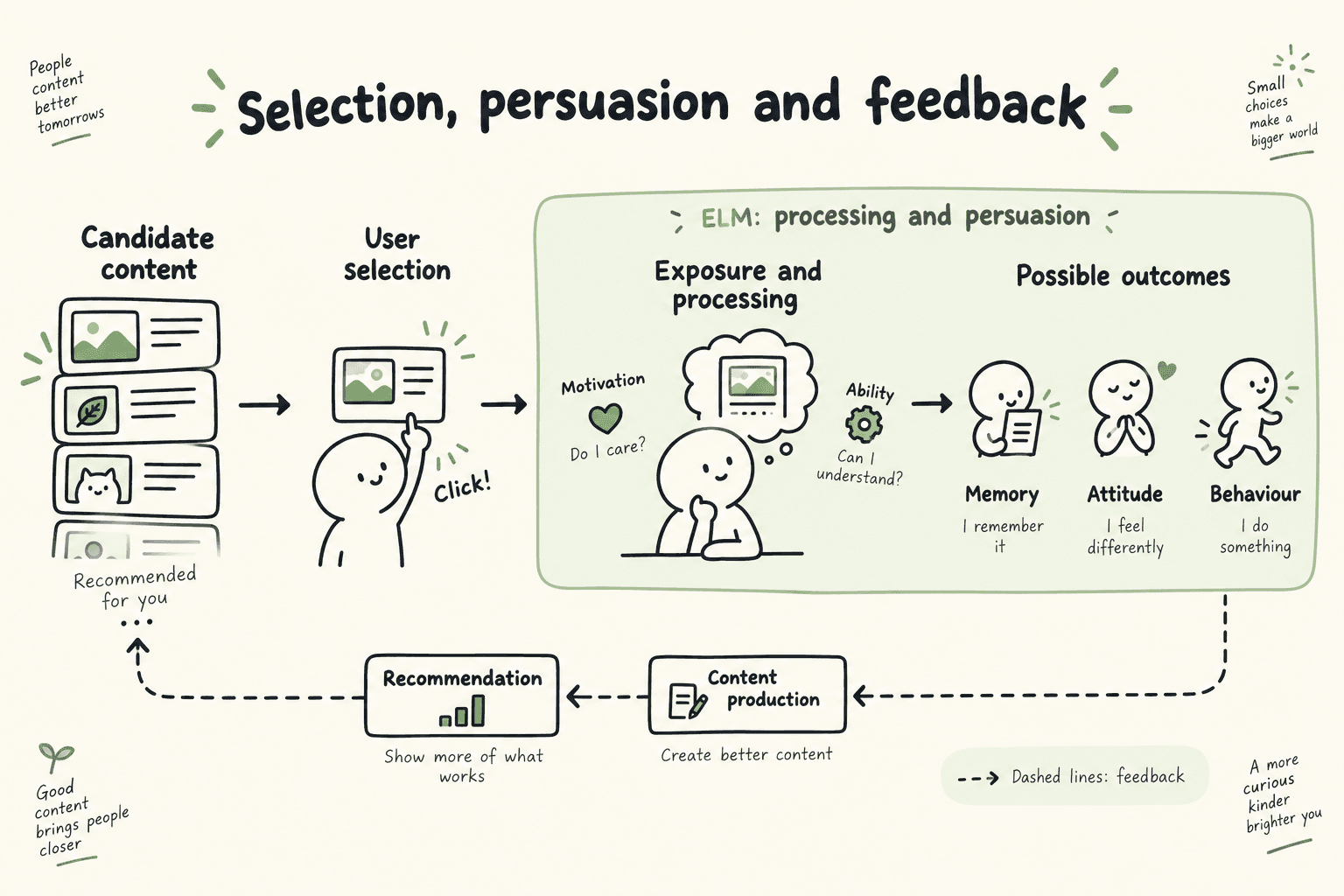
Figure 1. Selection, persuasion and feedback are connected processes. ELM helps explain persuasion within the loop, not every click or ranking decision.
4. More intense content does not prove a rising threshold
Three things could produce an increasingly intense feed. The recommendation system might concentrate on a type of content. Ordinary posts might seem less striking beside more dramatic ones. Or a user might become accustomed to a stimulus and respond less to it.
Only the last is directly a habituation claim. Seeing more intense content does not, on its own, tell us which process occurred.
Fatigue does not have a single outcome either. A person might leave, change topics, seek calmer material or move to a different form of entertainment. If user responses change, recommendations can change even without a new formal objective. None of that means the environment reliably corrects itself. It means an endless escalation is not the only possible path.
Motivation matters throughout. A person browsing casually and the same person searching for a product comparison may use the same platform differently. A long video can be entertainment; a short post can answer a serious question. Format is not a substitute for knowing the task.
5. Separate the outcomes you want to achieve
For a brand, attention, memory, attitude change and purchase are distinct outcomes. One piece of content may contribute to several, but evidence of one does not establish the others.
A click shows that the item was selected. It does not show that the brand was remembered, that the claim was believed or that the purchase was incremental. Equally, a brief or entertaining execution is not automatically incapable of leaving a useful association.
The practical response is to state the job before choosing the metric. A campaign intended to introduce an unfamiliar name needs evidence that people noticed and recognised that name. A claim intended to change an evaluation needs evidence of that change. A sales claim needs evidence appropriate to sales.
There should also be a useful next step for people who want more detail: clear product information, substantiated claims or an accessible answer to a question. Offering that detail does not guarantee deeper processing, but it makes it possible.
The attention economy creates a selection problem as well as a persuasion problem. ELM helps with part of the explanation. The stronger argument connects it to the surrounding feedback system without asking it to explain the entire system by itself.
Third in a series on the attention economy and brands. Next: what the history of sensational journalism can suggest about credibility—and why the analogy has limits.

